Viruses are completely different from all other microorganisms. These can be
observed under electron microscope only. They are present almost everywhere.
A virus is a tiny infectious particle that can reproduce only by infecting a host
cell. Viruses behave like a non-living material outside of a host body. In order to
live and reproduce it is essential that the virus enters inside a living cell. After
entering into a host cell it uses the resources of host to make more viruses. They do
so as they cannot reproduce by their own (without a host). That is why these are
called intracellular parasites.
Virus cannot reproduce because they do not have any cell; they are just a
packaging of a nucleic acid and protein. These are very small in size, much
smaller than the size of a living cell.
STRUCTURE OF VIRUS
There are a lot of different viruses in the world but they vary in their size, shape
and life cycle. However they have some features in common those are as follows:
A protective protein shell or capsid.
A nucleic acid genome made up of DNA or RNA enclosed by the capsid.
A layer of membrane called envelope (not for all viruses).
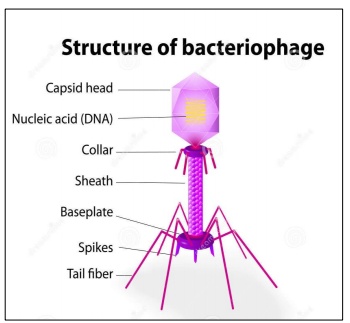
The body of a
bacteriophage is divided
into three parts:
i) Head
ii) Neck and hollow core
iii) Tail fibres
i) Head: The head is
hexagonal in shape. It
consists of a protein called
Capsid. Capsid encloses
the genetic material i.e.
DNA. They do not have a
cell membrane, nucleus
and cytoplasm.
ii) Neck and hollow core: The neck/collar helps in attachment of the virus
body to the head. The hollow core allows the passage of genetic material
enclosed within the capsid.
iii) Tail fibres: Spike like structures called tail fibres are present at the end of
the hollow core. They are attached to the hexagonal base plate. The tails fibres
help in adhering to the host cell.
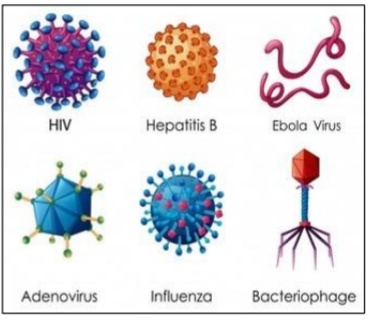
There are numerous viruses other than bacteriophage which can cause many fatal
diseases in other living organisms. A few
of them are as follows:
HIV – AIDS
Hepatitis B – Hepatitis B
Ebola – Ebola virus disease
Adenovirus – Respiratory illness
Influenza – Flu
Polio virus – Polio
Varicella-zoster virus – Chicken pox
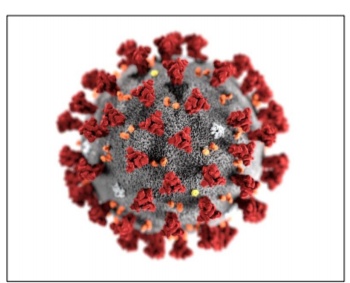
Corona Virus
Apart from these the most popular
virus now a day is NOVEL
CORONA VIRUS or
SARS CoV – 2
The disease caused by this is
Corona Virus Disease 2019
(COVID – 19)
This COVID – 19 is declared to be
a PANDEMIC.
This virus is best known for its
high contamination ability. Though its death rate is less than other viruses, its
contamination rate is far higher than any other viruses. The region which is mainly
affected by this virus is our respiratory system.
VIRAL INFECTION
A viral infection means that many viruses are using your cells to make more copies
of them. The viral lifecycle is the set of steps in which a virus recognizes and
enters a host cell, “reprograms” the host by providing instructions in the form of
viral DNA or RNA, and uses the host’s resources to make more virus particles.
Then these new virus particles exit from the host cell and infect other cells.
COMPARISON OF VIRUS AND BACTERIA
Even though they can both make us sick, bacteria and viruses are very different at
the biological level.
Bacteria are small and single-celled, but they are living organisms that do
not depend on a host cell to reproduce like the viruses do.
That is why bacterial and viral infections are treated very differently. For
instance, antibiotics are only helpful against bacteria, not viruses.
Bacteria are also much bigger than viruses.
 Site Title